No hot water usually traces to one of three things: lost fuel or power, a failed heating component, or a tank at the end of its life. Federal purchasing guidance assumes a 13 year product life for residential water heaters, so the age of the unit is the first question worth asking.
Hot Water Brief is an independent cost-research site. We are not a contractor and do not perform the work ourselves.
That is the short answer. Symptom by symptom diagnosis, from a pilot that will not stay lit to lukewarm water that runs out early, sits on the problems page at /problems/. If there is water on the floor, a relief valve discharging, or any smell of gas, start at /emergency/ instead.
The rest of this page is the other half of the question. Once a water heater has failed, most people are not choosing a repair in isolation. They are deciding between fixing what is there and buying something different, and that decision runs through type, fuel, size, efficiency and what the local code will require at install. Those are covered below, in that order.
Source: assumed product life from DOE Federal Energy Management Program purchasing guidance for residential water heaters, energy.gov, guidance updated May 2024.
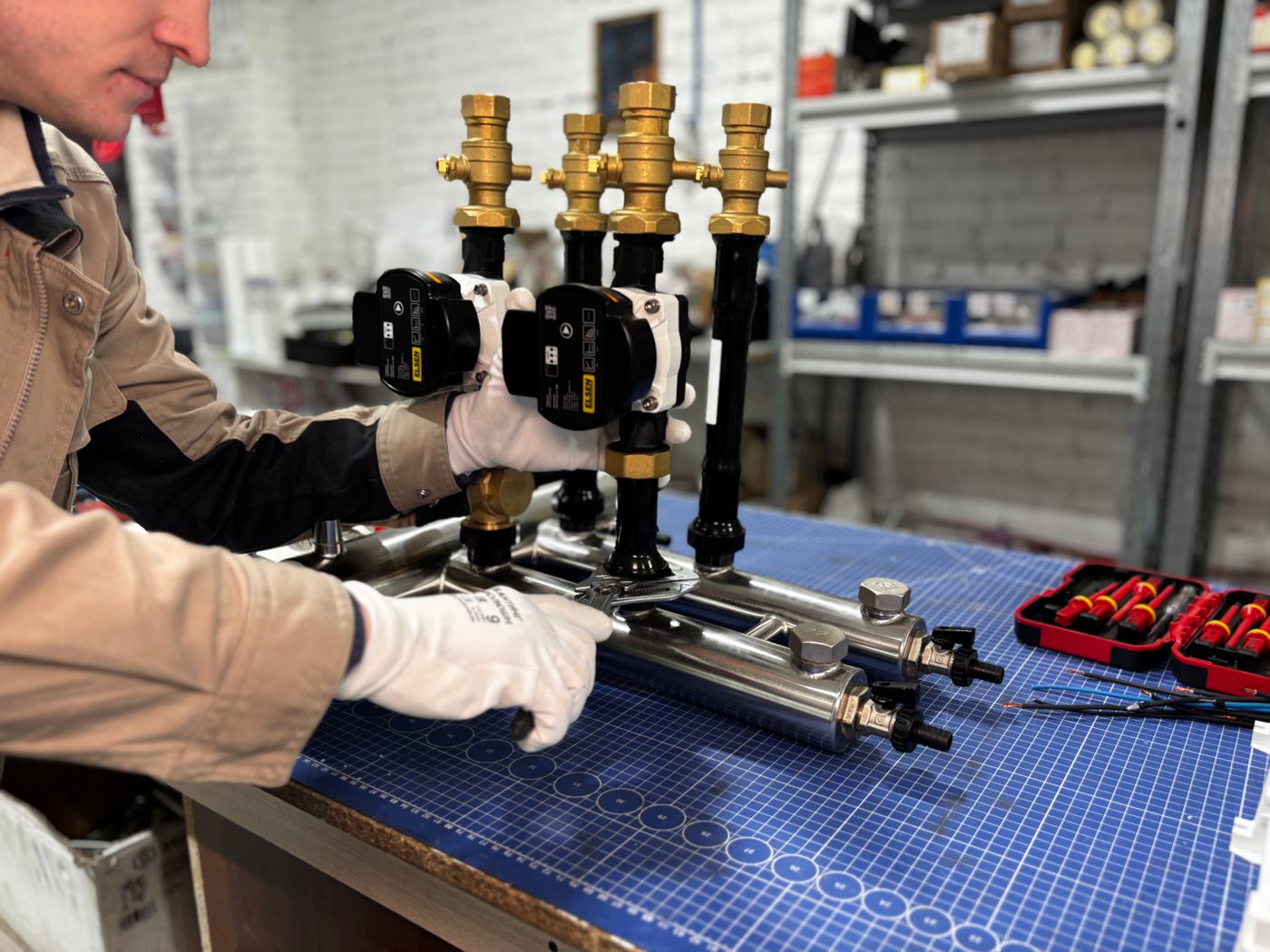
Three designs cover most homes: a storage tank, a tankless unit that fires on flow, and a heat pump tank that moves heat out of room air. Solar with a backup is a fourth. The right one is usually decided by the fuel and the space you already have.
A high efficiency gas storage tank is still a glass lined steel tank heated by a burner at the bottom. What makes it more efficient is better insulation, heat traps and a better burner, which ENERGY STAR describes as about 8 percent less energy use. A condensing model adds a secondary heat exchanger that pulls more heat out of the exhaust, cooling it until it condenses, which is why those units vent through vertical PVC and need a condensate drain.
| Type | How it heats water | Efficiency benchmark | Where it tends to fit |
|---|---|---|---|
| Gas storage tank | Burner under a glass lined steel tank | ENERGY STAR UEF 0.81 medium draw or 0.86 high draw, tanks over 20 up to 55 gallons | An existing gas line and a usable vent |
| Condensing gas storage | Secondary heat exchanger, exhaust cooled until it condenses | ENERGY STAR UEF 0.86 and above on tanks over 55 gallons | Larger draws, where a vertical PVC vent and a condensate drain are possible |
| Electric resistance storage | Elements inside the tank | Federal minimum only. The ENERGY STAR electric storage criteria are all heat pump | A 240 volt circuit is present but the space cannot host a heat pump |
| Heat pump or hybrid storage | Moves heat from room air into the tank | ENERGY STAR UEF 3.30 integrated, or 2.20 for 120 volt and split systems | A space of 450 to 700 cubic feet that stays between 40 and 90 degrees F |
| Gas tankless | Burner fires on flow, no stored volume | ENERGY STAR UEF 0.95 with at least 2.8 GPM over a 67 degree F rise | Long or repeated draws, where venting and gas supply can be sized for it |
| Electric tankless | Elements fire on flow | Federal minimum 0.91 to 0.92 UEF | Point of use duty. Whole home use is limited by the electrical service |
| Solar with backup | Collector plus a backup heater | ENERGY STAR SUEF 3.00 with electric backup, 1.80 with gas backup | A suitable roof, with the backup planned in from the start |
Source: ENERGY STAR residential water heaters key product criteria and high efficiency gas storage explainer, energystar.gov, accessed August 2026. Federal minimums at 10 CFR 430.32(d)(1).
One comparison to treat with care: the ENERGY STAR figures above are certification thresholds, not the performance of any particular model, and they are not comparable across product types. A heat pump UEF of 3.30 and a gas tankless UEF of 0.95 are measuring different things, because one moves heat and the other makes it.
Fuel is usually chosen for you by what the house already has. A gas unit needs a vent path suited to the appliance. Electric resistance and heat pump tanks usually need a 208 or 240 volt circuit, typically 30 amps, and a heat pump also needs air volume and a warm enough space.
The constraints that actually decide it:
Source: ENERGY STAR heat pump water heater design considerations and frequently asked questions, energystar.gov, accessed August 2026. Vent geometry from Ron George, Water heater permits and inspections, PHCP Pros, 7 April 2015. Circuit and wire gauge from A.O. Smith installation guidance, hotwater.com, accessed August 2026.
Size a tank by first hour rating, not by gallons. First hour rating is the most hot water a tank can deliver in an hour starting fully heated. Size a tankless unit by gallons per minute at your temperature rise, because the same unit delivers less when the incoming water is colder.
This is the part most guides skip. Gallons of storage tells you what the tank holds, not what it can deliver during the hour everybody showers, because a smaller tank with a stronger burner can outperform a larger tank with a weak one. The federal test procedure defines first hour rating as the maximum volume of hot water a non flow activated water heater can supply within an hour, measured from a fully heated start.
The federal draw pattern table is the most useful public sizing scale, because it maps household demand onto the exact ratings printed on the yellow label:
| Household demand | Federal draw pattern | Daily hot water in the test | Storage first hour rating | Tankless maximum flow |
|---|---|---|---|---|
| Very light | Very small usage | 10 gallons per day | 0 to under 18 gallons | 0 to under 1.7 GPM |
| Light | Low usage | 38 gallons per day | 18 to under 51 gallons | 1.7 to under 2.8 GPM |
| Average | Medium usage | 55 gallons per day | 51 to under 75 gallons | 2.8 to under 4.0 GPM |
| Heavy | High usage | 84 gallons per day | 75 gallons and above | 4.0 GPM and above |
Source: 10 CFR Part 430, Subpart B, Appendix E, uniform test method for water heaters, current edition, accessed August 2026.
For heat pump tanks specifically, ENERGY STAR publishes a minimum tank size by bedroom count, which is a reasonable starting point before checking the model's first hour rating:
| Bedrooms | Minimum heat pump tank size |
|---|---|
| 1 | 36 to 45 gallons |
| 2 | 45 to 59 gallons |
| 3 | 59 to 72 gallons |
| 4 or more | 72 gallons |
Source: ENERGY STAR heat pump water heater design considerations, energystar.gov, accessed August 2026.
Temperature rise is where tankless sizing goes wrong. A maximum flow figure is only meaningful next to the rise it was measured at. The federal test holds inlet water at 58 degrees F plus or minus 2 degrees and delivers at 125 degrees F plus or minus 5 degrees, which is a rise of about 67 degrees F, and maximum flow is taken over a 10 minute continuous flow test. ENERGY STAR requires a certified gas tankless unit to reach at least 2.8 GPM over that same 67 degree rise. Where the incoming main runs colder than the test inlet in winter, the same unit produces fewer gallons per minute at the same delivery temperature. That is the single most common reason a tankless unit that looked adequate on paper disappoints in January.
As a floor rather than a target, ENERGY STAR certification requires a first hour rating of at least 45 gallons per hour on electric heat pump tanks and at least 51 gallons per hour on gas storage tanks.
Uniform Energy Factor is the federal efficiency measure, taken from a 24 hour simulated use test. Every unit is placed in one of four draw pattern bins by its first hour rating or maximum flow, and each bin draws a different daily volume. That is why comparing across bins is misleading.
UEF replaced the older Energy Factor rating and is defined in regulation simply as the measure of water heater overall efficiency. The number itself comes out of a standardized 24 hour test in which the unit is drawn down on a fixed schedule while ambient temperature is held at 67.5 degrees F plus or minus 2.5 degrees for non heat pump units.
The bin is the part that trips people up. A unit assigned to the very small usage pattern is tested against 10 gallons of daily draw. A unit in the high usage pattern is tested against 84 gallons. Those are different tests, so two UEF numbers from different bins are not a like for like comparison, and a small unit's flattering UEF does not mean it will serve a household that draws 84 gallons a day. Compare within a bin, and check the bin before comparing.
The federal minimum is also written per bin, and it scales with rated volume:
| Product class | Draw pattern | Minimum UEF, units manufactured before 6 May 2029 |
|---|---|---|
| Gas storage, over 20 up to 55 gallons | Medium | 0.6483 minus 0.0017 times rated volume |
| Gas storage, over 20 up to 55 gallons | High | 0.6920 minus 0.0013 times rated volume |
| Gas storage, over 55 up to 100 gallons | Medium | 0.7897 minus 0.0004 times rated volume |
| Gas storage, over 55 up to 100 gallons | High | 0.8072 minus 0.0003 times rated volume |
| Gas instantaneous, under 2 gallons, over 50,000 Btu per hour | All | 0.80 to 0.81 |
| Electric instantaneous, under 2 gallons | All | 0.91 to 0.92 |
Source: 10 CFR 430.32(d)(1), current edition, accessed August 2026. Rated volume is the tank's rated storage volume in gallons.
What the efficiency gap is worth in running cost is published too. Federal purchasing guidance models three electric options over an assumed 13 year product life, a 3 percent discount rate and electricity at 9.9 cents per kWh:
| Electric option | UEF | Annual energy use | Annual energy cost | Lifetime energy cost |
|---|---|---|---|---|
| Best available heat pump | 3.93 | 826 kWh | $82 | $792 |
| ENERGY STAR heat pump | 3.30 | 984 kWh | $97 | $940 |
| Less efficient electric | 0.95 | 3,437 kWh | $340 | $3,440 |
Source: DOE Federal Energy Management Program, purchasing energy efficient residential water heaters, energy.gov, guidance updated May 2024.
Those figures are modeled at a federal electricity price, so treat the gap between the rows as the transferable finding rather than the absolute dollars. The same guidance splits savings by draw pattern, and the spread is wide: annual savings of $44 in the very small bin at 10 gallons a day, against $371 in the high bin at 84 gallons a day. Efficiency is worth most to households that use the most hot water.
They set a floor for what manufacturers may build, not for what you may keep. The current minimums apply to water heaters manufactured before 6 May 2029. Higher levels apply to units manufactured on and after that date, under a rule published in the Federal Register on 6 May 2024.
The distinction matters when a salesperson tells you a rule forces your hand this year. The regulation is written by date of manufacture. Section 10 CFR 430.32(d)(1) sets the minimum UEF for units manufactured before 6 May 2029, and 430.32(d)(2) sets the higher levels for units manufactured on and after it, reorganizing the classes around an effective storage volume.
The 2024 rule itself became effective on 5 July 2024, with compliance required on and after 6 May 2029. Announcing it on 30 April 2024, DOE said it expected the standards to result in over 50 percent of newly manufactured electric storage water heaters using heat pump technology, compared with 3 percent at the time, and estimated savings of roughly $1,800 per appliance over its life, about $7.6 billion a year across American households, and $124 billion over 30 years. DOE also noted that water heating is roughly 13 percent of annual residential energy use and cost.
Not every proposed standard survives. A separate DOE rule for consumer gas fired instantaneous water heaters, published on 26 December 2024, was nullified by a joint resolution of disapproval signed on 9 May 2025, and DOE withdrew it under the Congressional Review Act. Anyone budgeting a tankless replacement on the assumption that the gas tankless standard tightened should check that the rule they read about still exists.
Source: 10 CFR 430.32(d), current edition. DOE final rule, Energy Conservation Standards for Consumer Water Heaters, Federal Register, 6 May 2024. DOE announcement, 30 April 2024, energy.gov. Withdrawal of the consumer gas fired instantaneous water heater standards, Federal Register, 20 May 2025.
A permit and an inspection, in most places. Beyond that: a vent that matches the appliance, a temperature and pressure relief valve piped to discharge safely, an expansion tank if the system is closed, a drain pan where a leak would do damage, and seismic anchoring where the jurisdiction requires it.
Writing in PHCP Pros, plumbing engineer Ron George put the permit question plainly: a permit is required because a water heater is one of the most dangerous appliances in a building. What the inspector then looks at is fairly consistent, even though the detail varies by jurisdiction.
Source: Ron George, Water heater permits and inspections, PHCP Pros, 7 April 2015. A.O. Smith installation guidance, hotwater.com, accessed August 2026. ENERGY STAR heat pump water heater design considerations and high efficiency gas storage explainer, energystar.gov, accessed August 2026.
Because plumbing and mechanical codes are adopted and amended locally, the only reliable answer on permits, seismic restraint and pan requirements is the one your local building department gives. A licensed installer normally files the permit and schedules the inspection as part of the job.
Federal purchasing guidance assumes a 13 year product life for residential water heaters, and ENERGY STAR uses the same 13 years in its savings calculations. What shortens it is mostly water: hardness that leaves scale and sediment, a sacrificial anode left past its useful life, and pressure that is never relieved.
The anode rod is the part almost nobody thinks about and the one that decides how long a steel tank survives. It corrodes so the tank does not. A.O. Smith's guidance is to check it every few years and replace it when more than 6 inches of the wire core is exposed. Once it is spent, the tank is next.
Water chemistry sets the pace. The US Geological Survey classifies water by hardness as calcium carbonate: soft at 0 to 60 mg per liter, moderately hard at 61 to 120, hard at 121 to 180, and very hard above 180. The harder the supply, the faster scale and sediment build in a tank and the faster the same minerals deposit on a tankless heat exchanger, which is why descaling is a routine maintenance item on tankless units rather than an unusual repair.
Pressure is the third factor and the easiest to overlook. A closed system with no expansion tank can run at pressures around 150 psi against the 80 psi that correct installation is meant to hold, and A.O. Smith attributes premature tank failure to exactly that. A tank that fails at year seven quite often failed for a reason that was designed in on day one.
One more thing worth knowing: a heat pump water heater's efficiency depends on the air around it. If intake air falls below roughly 40 degrees F, the unit falls back on resistance elements, so a garage installation in a cold climate will not deliver the running costs the label implies.
Source: assumed 13 year product life from DOE Federal Energy Management Program guidance, energy.gov, updated May 2024, and ENERGY STAR heat pump water heater savings assumptions, energystar.gov, accessed August 2026. Anode guidance from A.O. Smith, hotwater.com. Hardness classification from the US Geological Survey water science school, www.usgs.gov/special-topics/water-science-school/science/hardness-water. Pressure figures from PHCP Pros, 7 April 2015.
Repair is usually reasonable when the failed part is a control, a heating element, a valve or an igniter, and the tank itself is sound. A leaking tank is not a repair. Age matters too, because a unit near the 13 year planning life is spending money on a short remaining run.
There are three questions worth separating. First, what actually failed, which is a diagnostic question and belongs on the problems page at /problems/. Second, what each option costs, which is a pricing question and belongs on the cost page at /cost/. Third, what the running cost difference is between what you have and what you would buy, which is where the efficiency figures above earn their keep.
On that third question, the published numbers are unusually clear. Federal purchasing guidance puts the annual energy cost of a less efficient electric water heater at UEF 0.95 near $340, against $97 for an ENERGY STAR certified heat pump at UEF 3.30, at a federal electricity price and an assumed 13 year life. ENERGY STAR separately models a family of four saving about $550 a year against a standard electric water heater, and more than $5,610 over the unit's lifetime, on assumptions of 14.6 cents per kWh, an incremental cost of $1,503, and a 13 year lifespan. Whether those assumptions resemble your electricity price is the question to ask before treating them as a forecast.
What we will not do is tell you which way to go. Prices, availability and the condition of your specific installation vary, and only a licensed local company that has seen the unit can tell you what is repairable. Hot Water Brief publishes the sourced background; the choice of company is yours.
Source: DOE Federal Energy Management Program purchasing guidance for residential water heaters, energy.gov, updated May 2024. ENERGY STAR heat pump water heater savings and benefits, energystar.gov, accessed August 2026.
Three pages carry the rest. The problems page works through symptoms one by one and covers repair. The cost page carries published price ranges for repair and replacement. The emergency page covers leaks, water on the floor and anything involving gas. Start where your situation actually sits.
Every figure on this page comes from a federal regulation, a federal agency, an ENERGY STAR specification or a dated trade publication, and each is listed below with the date it was published or accessed. Where a source gives a range, the range is reproduced rather than reduced to one number.
Use first hour rating for a tank and gallons per minute at your temperature rise for a tankless unit. The federal draw pattern scale maps demand onto those ratings: a first hour rating of 51 to under 75 gallons sits in the medium usage bin, tested at 55 gallons of daily draw, and 75 gallons or more sits in the high usage bin at 84 gallons a day.
Because UEF is measured inside a draw pattern bin. A unit in the very small usage bin is tested against 10 gallons of daily draw, and one in the high usage bin against 84 gallons. Those are different tests, so the ratings are only comparable within the same bin. Check the bin, which is set by first hour rating or maximum flow, before comparing the numbers.
In most places yes, and the installation is inspected. PHCP Pros puts the reason plainly: a permit is required because a water heater is one of the most dangerous appliances in a building. Inspectors check venting, relief valve discharge, the expansion tank on a closed system, the drain pan and seismic restraint. The detail varies by jurisdiction, so confirm with your local building department.
Not today. The current federal minimums apply to units manufactured before 6 May 2029, and higher levels apply to units manufactured on and after that date under a rule published on 6 May 2024. DOE expects over 50 percent of newly manufactured electric storage water heaters to use heat pump technology after that, against 3 percent when the rule was announced.
It contributes. The US Geological Survey classifies water above 180 mg per liter as calcium carbonate as very hard, against 0 to 60 for soft water. Harder supplies leave more sediment in a tank and more scale on a tankless heat exchanger. Combined with a spent anode rod, that is a common reason a unit falls short of the 13 year product life federal guidance assumes.
Often not. ENERGY STAR guidance points to interior spaces that stay between 40 and 90 degrees F year round, with 450 to 700 cubic feet of air. Where intake air drops below roughly 40 degrees F the unit falls back on electric resistance elements, so the modeled savings, about $550 a year for a family of four against a standard electric tank, will not be realized.
Independent Research
Published ranges for tank and tankless replacement, the failures that justify a repair, and the ones that do not. Sourced, dated, and free to read.