Most water heater faults trace to one of six things: a failed heating element or thermostat, a dead pilot or igniter, sediment, a stuck relief valve, a corroded tank, or scale in a tankless heat exchanger. Fixr put the national average repair at $450 in August 2025, with most jobs between $150 and $750.
Hot Water Brief is an independent cost-research site. We are not a contractor and do not perform the work ourselves.
Start with the symptom rather than the unit. The table below points each common complaint at the section that covers it, and flags the ones that are a safety matter first and a repair decision second.
| Symptom | What it usually points at | Treat as a safety matter |
|---|---|---|
| No hot water at all | Tripped limit switch, failed element, dead pilot, no gas at the burner | Yes if you can smell gas |
| Hot water runs out quickly | Sediment, failed lower element, broken dip tube | No |
| Water is warm but never hot | Thermostat setting, one failed element, scale in a tankless exchanger | Yes if the fix is turning the temperature up |
| Water pooling under the unit | Relief valve discharge, a fitting, or a corroded tank | Yes, water and a live electrical connection |
| Pilot or burner will not stay lit | Thermocouple, flame sensor, blocked flue, gas pressure | Yes, a blocked flue is a carbon monoxide risk |
| Error code on a tankless display | Ignition, flame loss, venting, condensate, or scale | Yes for anything on the gas side |
| Rumbling or popping from the tank | Sediment on the tank floor | No |
| Rusty or smelly hot water | Anode rod chemistry, or a corroding tank | No |
Two divides run through everything below. The first is tank against tankless, because a storage tank tends to fail by corroding and a tankless unit tends to fail by scaling. The second is repairable part against failed vessel: nearly every component bolted to a water heater can be replaced, and the tank itself cannot.
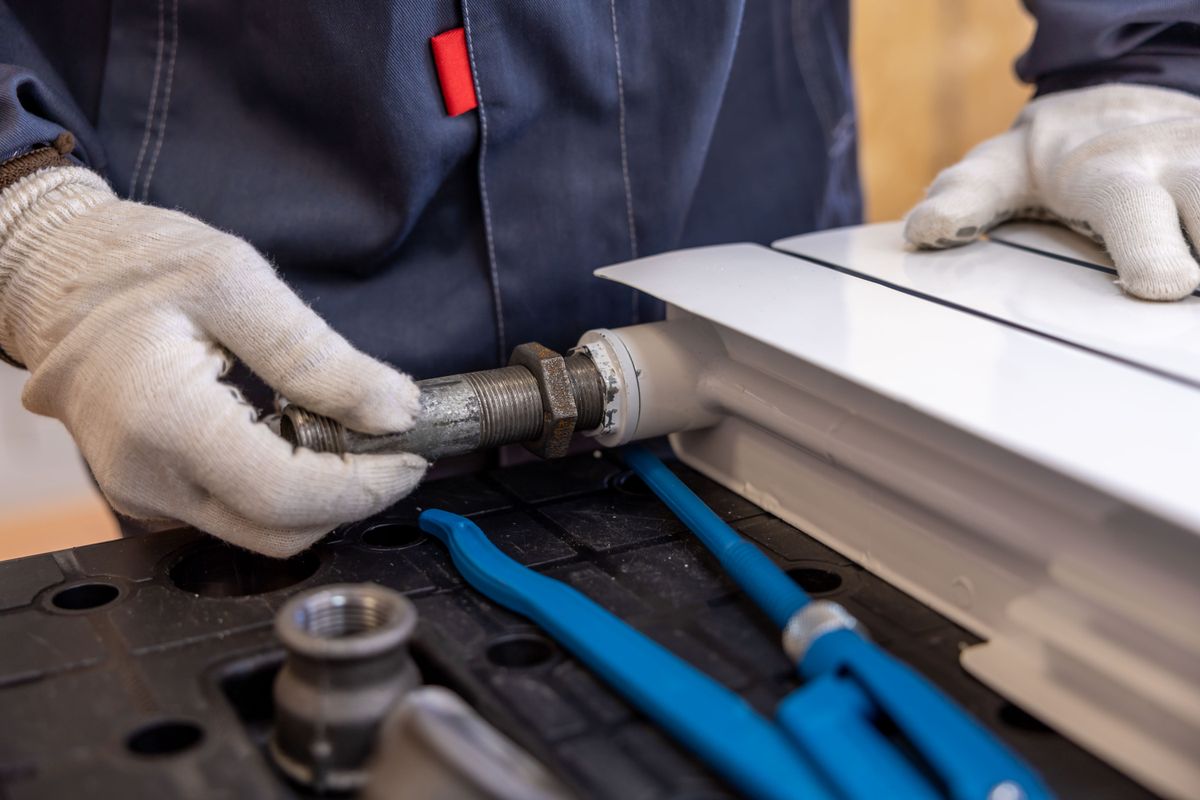
No hot water at all usually means the heat source stopped, not that the tank failed. On electric units that is a tripped high limit switch or a burned out upper element. On gas units it is a dead pilot, a failed thermocouple or igniter, or no gas reaching the burner.
Before calling anyone, two checks are safe to make. Confirm the breaker serving the water heater has not tripped, and confirm other gas appliances in the house still work, which tells you whether the gas supply itself is the problem. Do not open the burner compartment and do not test gas pressure.
If you can smell gas, stop. The Pipeline and Hazardous Materials Safety Administration tells people to leave the area on foot at once, not to try to locate the source, not to operate any valves, and to call 911 from a safe location before notifying the utility. Do not troubleshoot a water heater you can smell gas around.
| Unit | Failure that removes hot water entirely | Typical repair range |
|---|---|---|
| Electric | Upper heating element burned out | $200 to $750 for the element |
| Electric | Thermostat failed or high limit tripped | $100 to $250 for the thermostat |
| Electric | Blown fuse or breaker fault | $50 to $75 for a fuse, $100 to $225 for breaker work |
| Gas | Thermocouple no longer proving the pilot flame | $150 to $325 |
| Gas | Pilot assembly or igniter | $75 to $175 |
| Gas | Gas control valve | $100 to $300 |
Source: Fixr, Water Heater Repair Cost, updated 29 August 2025. These are national ranges, not a quote for your job.
One thing this is not: a tank that has run out of capacity. That produces water which starts hot and turns cold, which is the next question rather than this one.
Running out fast points at capacity lost inside the tank, not at the burner. ENERGY STAR lists sediment build up as a cause, saying it reduces the volume of water available to be heated. A failed lower heating element, a broken dip tube, or a thermostat set low will produce the same complaint.
On an electric unit the pattern is diagnostic in itself. A failed upper element gives no hot water at all. A failed lower element gives a short burst of hot water and then cold, because only the top of the tank is being heated.
Tankless units produce the same complaint for a different reason. Scale inside the heat exchanger cuts heat transfer, so the unit cannot lift the water temperature across the flow it is being asked to handle. Noritz documents this as error code 16 and says annual descaling, or a water softener, prevents it. A cold burst arriving between two hot ones, often called a cold water sandwich, is separate behavior caused by the delay between demand and ignition.
| Complaint | Likely cause | Typical repair range |
|---|---|---|
| Hot for a few minutes then cold, tank unit | Lower heating element failed | $200 to $750 |
| Volume dropped gradually over a year or more | Sediment reducing usable tank volume | $150 to $750 for tank work |
| Lukewarm at every tap | Thermostat setting, or a failed thermostat | $100 to $250 |
| Tankless output weak under demand | Scale or clogging in the exchanger | $150 to $450 |
| Tankless pressure low at the tap | Flow restriction or a flow switch fault | $75 to $500 |
| Cold burst between hot water, tankless | Cold water sandwich behavior | $300 to $1,000 |
Source: ranges from Fixr, Water Heater Repair Cost, updated 29 August 2025, and Fixr, Tankless Water Heater Repair Cost, published 31 January 2025.
Resist the urge to solve this by turning the thermostat up. CPSC urges households to set water heaters to 120°F, because at 150°F most adults suffer third degree burns after two seconds of exposure.
It depends entirely on where the water is coming from. Fittings, the drain valve and the relief valve are repairable parts. A leak from the tank body is not. Fixr's cost guide, updated in August 2025, states that once rust develops in the tank it cannot be fixed, and the unit is replaced rather than repaired.
The temperature and pressure relief valve is worth understanding before you assume it has failed. Writing for the International Code Council in May 2019, Charles Lee Clifton described it as an important safety device for the water heater and for the water distribution system, and noted that any water discharge from it indicates a problem needing attention. The codes require its discharge pipe to end where occupants can readily observe it, with no valve or tee in the line, no threaded connection at the end that could be capped off, a termination not more than six inches above the floor or receptor, and materials rated to at least 100 psi at 180°F. Water at that pipe is the system reporting something, not a nuisance drip to be plugged.
| Where the water appears | What it usually is | Repairable |
|---|---|---|
| At a threaded fitting on top of the tank | Loose or corroded connection | Yes |
| At the drain valve | Worn valve seat | Yes, $75 to $150 for valve work |
| At the end of the relief discharge pipe | The relief valve opening on temperature or pressure | Yes, but the underlying cause has to be found first |
| Seeping from under the unit with no fitting above it | Corrosion through the tank wall | No, the unit is replaced |
| Around the case of a tankless unit | Fitting, gasket, or the heat exchanger | Depends, $50 to $600 |
Source: repair ranges from Fixr, updated 29 August 2025 and 31 January 2025. Relief valve and discharge pipe requirements from the International Code Council, May 2019.
ENERGY STAR treats leaks from any joints, seals or seams as a sign of internal breakdown, often from corrosion, and lists visible corrosion as evidence that the heater is breaking down. If there is standing water around a powered unit, shut off the breaker or the gas supply and close the cold water inlet, then have a licensed professional look at it. Water and a live electrical connection together are a shock hazard, and this is not a diagnosis to make while standing in it.
A pilot that lights and then dies almost always means the thermocouple is not proving the flame, so the gas valve shuts itself. The other causes are a dirty pilot orifice, a blocked flue, or low gas pressure. Fixr lists pilot light repair at $75 to $175 and thermocouple replacement at $150 to $325.
The reason this fault matters more than its price is what sits behind it. CPSC recommends a yearly professional inspection that checks chimneys, flues and vents serving furnaces, water heaters and boilers for leakage, for blockage by debris, and for loose or disconnected joints. A flue that is blocked or has come apart sends combustion products into the house instead of out of it. CPSC describes early carbon monoxide symptoms as resembling flu without the fever: headache, fatigue, shortness of breath, nausea and dizziness.
The Department of Energy's Building America Solution Center warns that on a gas water heater you should follow the manufacturer's instructions closely to avoid accidentally turning off the pilot light, because that can allow gas to leak into the home. CPSC also notes that gas water heater thermostats differ between models and advises calling your gas company for instructions rather than guessing at them.
Newer gas units with electronic ignition have no standing pilot at all. On those, a repeated failure to light is reported as an error code rather than a dead flame, which is the next question.
An error code is the unit telling you which of its own safety checks failed. Most fall into four families: ignition, flame loss, airflow or venting, and scale. Noritz documents code 11 as ignition failure and code 16 as scale build up, and says a licensed contractor is needed to check gas pressures and test the spark.
Codes are manufacturer specific, so the number on your display only means something against that brand's list. The families below hold across brands, which is what makes them useful when you are standing in front of a blinking display.
| Fault family | Example codes | What the unit is reporting | Reasonable homeowner check |
|---|---|---|---|
| Ignition failure | Noritz 11, Navien E003 | Demand for hot water, but no successful light | Confirm the gas supply valve is open and the propane tank is not empty |
| Flame loss | Noritz 12, Navien E012 | Flame lit but did not stay lit | Clean the intake air filter, confirm the unit is properly grounded |
| Combustion abnormality | Noritz 90 | Insufficient gas supply, a blockage in a fuel vent, or debris in the fan motor | None, this one goes to a contractor |
| Scale build up | Noritz 16 | Mineral deposits cutting heat transfer efficiency | None on the gas side, but annual descaling prevents it |
| Exhaust overheating | Navien E030 | Unit shuts down when flue temperature passes 149°F | Clean the cold water inlet filter, flush the heat exchanger |
| Condensate drainage | Noritz 29 | Blocked drain line or improper drain piping | Clear debris from the drain line |
| Control board settings | Noritz 73 | A jumper or dip switch changed during operation | Power cycle once, then call a licensed contractor |
Source: Noritz, Common Noritz Tankless Error Codes, 21 May 2019, and Five Common Tankless Water Heater Error Codes, 6 June 2022. Navien codes from the NPE-2 user's information manual.
Two details are worth knowing. Noritz says code 90 appears after three failed attempts to reach the set temperature, so it reflects a pattern rather than a single event. And a flow malfunction may show no code at all, because when hot water demand sits below the unit's minimum activation flow the heater simply never fires.
On cost, Fixr's tankless guide of 31 January 2025 puts ignition failure repair at $100 to $300, a clog or scaling issue at $150 to $450, and a unit that shuts itself off at $50 to $500.
By error code or unit:
Sediment. Minerals settle on the floor of a storage tank, water becomes trapped beneath the layer, and it boils through with a popping or rumbling sound. The Department of Energy's Building America Solution Center notes that sediment collecting in the tank leaves mineral deposits on the heating element and reduces how effectively it transfers heat to the water.
ENERGY STAR treats unusual noises as a sign the water heater is likely straining to operate correctly, and attributes them to sediment accumulation. The noise itself is not dangerous. What it signals is a unit working harder than it should, on its way to a shorter life.
Flushing the tank is the standard response, and the Building America Solution Center publishes the procedure. Two of its cautions matter more than the steps: a water heater that fires while empty or partly empty can be damaged quickly, and on a gas unit the manufacturer's instructions have to be followed to avoid accidentally shutting off the pilot light, which could allow gas to leak into the home. If either of those is unfamiliar territory, this is a job to hand over.
Tankless units make noise for the opposite reason. There is no tank floor for sediment to settle on, so the problem is scale bonded inside the heat exchanger. The Building America Solution Center recommends cleaning a tankless unit's water and air filters every 6 to 12 months for best efficiency and performance, and notes that a clogged air filter will stop the unit from working until it is cleaned.
| Noise | Unit type | Cause | Typical repair range |
|---|---|---|---|
| Rumbling or popping while heating | Tank | Sediment layer on the tank floor | $150 to $750 for tank work |
| Sizzling near the base | Tank | Water on a burner assembly, often from a leak | Diagnose the leak first |
| Loud rumbling under demand | Tankless | Scale in the heat exchanger | $100 to $650 |
| Unit stops mid draw with no noise | Tankless | Clogged filter or a flow fault | $50 to $500 |
Source: repair ranges from Fixr, updated 29 August 2025 and 31 January 2025. Maintenance guidance from the Department of Energy's Building America Solution Center, updated 10 September 2025 and 22 July 2025.
Run the cold tap first. If only the hot water smells or looks wrong, the heater is the source. UGA Cooperative Extension explains that a rotten egg smell in the hot water alone points at the heater's magnesium corrosion control rod, which converts naturally occurring sulfates in the water into hydrogen sulfide gas.
That publication, Circular 858-8, gives the remedy as replacing the magnesium rod with one made of aluminum or zinc, preferably by a licensed plumber, and adds that if water temperature is held above 150°F only an aluminum rod should be used. It also notes that most people can detect hydrogen sulfide at concentrations as low as 0.5 parts per million, which is why a small chemical change produces a smell you cannot ignore. Fixr puts anode rod replacement at $125 to $300, and a rotten egg smell on a tankless unit at $200 to $600.
Rusty or brown hot water is a different signal and a worse one. ENERGY STAR states that rust in the water is usually a sign the interior of the water heating system is corroding. Fixr's guide is blunt about where that ends: once rust develops in the tank it cannot be fixed. Discolored hot water on an older tank is generally a replacement conversation rather than a repair one.
| What you notice | Test | What it usually means | Typical range |
|---|---|---|---|
| Rotten egg smell, hot water only | Smell the cold tap | Anode rod chemistry inside the heater | $125 to $300 for the rod |
| Rotten egg smell, hot and cold | Smell the cold tap | The water supply, not the heater | Water treatment, not a heater repair |
| Rusty or brown hot water only | Run the cold tap | The tank interior is corroding | Usually replacement |
| Metallic taste with clear water | Compare hot and cold | Anode rod nearing the end of its life | $125 to $300 for the rod |
Source: odor diagnosis and anode rod guidance from UGA Cooperative Extension, Circular 858-8, reviewed 17 July 2026. Corrosion guidance from ENERGY STAR, 2 February 2024. Cost ranges from Fixr, updated 29 August 2025 and 31 January 2025.
Fixr's cost guide, updated 29 August 2025, puts the national average at $450, with most repairs landing between $150 and $750, a low end of $75 and a high end of $2,000. Its separate tankless guide, published 31 January 2025, gives a national average of $375 and a typical range of $100 to $650.
What moves a job inside that range is which part failed and how much of the unit has to come apart to reach it. The three tables below split it the way the failure actually presents: by unit and fuel, by part on a storage tank, and by symptom on a tankless unit.
| Unit or fuel | Typical repair range |
|---|---|
| Tankless | $100 to $650 |
| Storage tank | $150 to $750 |
| Hybrid or heat pump | $150 to $900 |
| Electric | $100 to $650 |
| Gas | $150 to $750 |
| Propane | $150 to $750 |
| Solar | $150 to $900 |
Source: Fixr, Water Heater Repair Cost, updated 29 August 2025.
| Part replaced on a storage tank | Typical range |
|---|---|
| Fuse | $50 to $75 |
| Pilot light assembly | $75 to $150 |
| Thermostat | $100 to $250 |
| Dip tube | $100 to $250 |
| Valve | $100 to $300 |
| Anode rod | $125 to $300 |
| Thermocouple | $150 to $325 |
| Heating element | $200 to $750 |
| Circulating pump | $350 to $800 |
| Tank | $600 to $2,000 |
Source: Fixr, Water Heater Repair Cost, updated 29 August 2025.
| Tankless problem | Typical range |
|---|---|
| Unit shuts off | $50 to $500 |
| Leak | $50 to $600 |
| Low pressure | $75 to $500 |
| Ignition failure | $100 to $300 |
| Loud rumbling | $100 to $650 |
| Clog or scaling | $150 to $450 |
| Frozen pipes | $200 to $550 |
| Rotten egg smell | $200 to $600 |
| Rust | $200 to $800 |
| Cold water sandwich | $300 to $1,000 |
Source: Fixr, Tankless Water Heater Repair Cost, published 31 January 2025.
Every figure above is a national range published by a cost guide, not a price for your home. Local labor rates, access to the unit, and whether a part is still made all move the number. Hot Water Brief does not set prices and does not quote work.
Three things decide it: the age of the unit, what failed, and what the part costs against a whole new heater. ENERGY STAR's guidance, published 2 February 2024, is that a water heater suspected of being more than ten years old is worth replacing before it fails. A leaking tank removes the choice altogether.
ENERGY STAR lists five signs it treats as replacement territory: visible corrosion, water leaking from joints, seals or seams, rust in the water, not enough hot water, and rumbling noises. It also makes the practical argument for acting early, noting that a sudden failure forces an emergency replacement, which can cost more and typically limits the choice to less efficient models.
Warranty status is the other input people forget. Rheem's residential gas tankless warranty covers the heat exchanger for twelve years, component parts for five years, and certain labor for one year when the unit is installed in a single family dwelling. A heat exchanger fault in year eight is a very different conversation from the same fault out of warranty, so the serial number is worth checking before anyone quotes the work.
| Situation | What usually makes sense |
|---|---|
| Under about eight years, part under roughly $300 | Repair. Fixr puts thermostats at $100 to $250 and anode rods at $125 to $300 |
| Any age, tank leaking through the wall | Replace. Fixr states rust in the tank cannot be fixed |
| Over ten years, any significant failure | ENERGY STAR advises planning replacement at this age |
| Tankless in warranty, heat exchanger fault | Check the warranty first. Rheem covers the exchanger twelve years, parts five, labor one |
| Tankless, scale related fault | Repair, then adopt a descaling routine. Noritz says annual descaling or a softener prevents the scale code |
| Repair quote approaching the $600 to $2,000 tank replacement band | Compare against a new unit before committing |
Source: ENERGY STAR, 2 February 2024. Cost ranges from Fixr, updated 29 August 2025 and 31 January 2025. Warranty terms from Rheem's residential gas tankless warranty document.
One more input that is easy to overlook: the reason the unit failed. A tank that corroded through at year seven in hard water, or a tankless exchanger that scaled shut without ever being flushed, will do the same thing to its replacement unless the water is dealt with.
Anything involving gas, venting, or a live electrical connection near standing water. CPSC's scald data shows how narrow the margin is on temperature as well: at 150°F most adults suffer third degree burns after two seconds, and CPSC urges households to set the water heater thermostat to 120°F.
| Water temperature | Exposure that can cause a third degree burn in most adults |
|---|---|
| 120°F | 5 minutes |
| 130°F | 30 seconds |
| 140°F | 6 seconds |
| 150°F | 2 seconds |
Source: U.S. Consumer Product Safety Commission, Avoiding Tap Water Scalds, Publication 5098, March 2012.
CPSC also reports that the majority of injuries and deaths involving tap water scalds are to the elderly and to children under the age of five, which is why the recommended setting is a household decision rather than a preference.
Hot Water Brief is an information site. We do not perform repairs, hold licenses, or set prices, and we make no claim about how quickly any company will respond or what any job will cost. What we do is publish sourced ranges so you can judge a quote from a licensed local company.
Every number on this page traces to a published, dated source, listed below with its date. Cost guides are named as cost guides, and the safety and maintenance guidance comes from federal agencies, model code bodies, university extension publications and manufacturer documentation rather than from us.
A licensed plumber for most tank faults, and a licensed plumbing or gas contractor for anything on the gas side of a tankless unit. Noritz, for example, directs owners to a licensed contractor to check gas pressures and test the spark on an ignition failure code. If you can smell gas, leave the area on foot and call 911 from a safe location before notifying the utility, per Pipeline and Hazardous Materials Safety Administration guidance.
Only if the leak is at a fitting, the drain valve or the relief valve. Fixr's cost guide, updated 29 August 2025, states that once rust develops in the tank it cannot be fixed, so a tank leaking through its wall is replaced rather than repaired. Drain valve work runs about $75 to $150, while tank replacement sits in the $600 to $2,000 band.
Usually not for a major component. ENERGY STAR's guidance, published 2 February 2024, is that a heater suspected of being more than ten years old is worth replacing before it fails, because a sudden failure forces an emergency replacement that can cost more and typically limits the choice to less efficient models. A minor part such as a thermostat, at $100 to $250, can still be worth fixing.
Fixr's tankless guide, published 31 January 2025, gives a national average of $375 and a typical range of $100 to $650, with a low end of $50 and a high end of $1,000. Broken out by problem, ignition failure runs $100 to $300 and a clog or scaling issue runs $150 to $450. Local labor rates move these figures, and no site can quote your job.
Run the cold tap first. If only the hot water smells, UGA Cooperative Extension points at the magnesium corrosion control rod inside the heater, which converts naturally occurring sulfates into hydrogen sulfide gas. The remedy is swapping it for an aluminum or zinc rod, preferably by a licensed plumber, and only aluminum if the water is held above 150°F. Most people detect hydrogen sulfide at around 0.5 parts per million.
Sediment on the floor of the tank. ENERGY STAR treats unusual noises as a sign the unit is straining to operate correctly, usually from sediment accumulation, and the Department of Energy's Building America Solution Center notes that sediment leaves mineral deposits on the heating element and reduces how effectively it transfers heat. Flushing the tank is the standard response.
Independent Research
Published ranges for tank and tankless replacement, the failures that justify a repair, and the ones that do not. Sourced, dated, and free to read.