A water heater thermostat replacement typically costs $100 to $250 for parts and labor combined, according to Fixr's national repair cost guide, updated 29 August 2025. Electric tank units run two thermostats, upper and lower, and either one can cause a complete loss of hot water that looks identical to a failed heating element.
Hot Water Brief is an independent cost-research site. We are not a contractor and do not perform the work ourselves.
A broader repair visit that includes checking, adjusting or replacing the thermostat, rather than a stand-alone swap, runs $303 to $365 per Homewyse's national estimate dated May 2026. Homewyse defines that job as flushing the tank, inspecting the temperature control and pressure relief components, and adjusting, repairing or replacing the thermostat if needed, billed against a two hour minimum labor charge.
| Job | Typical range | Midpoint |
|---|---|---|
| Thermostat, parts and labor | $100 to $250 | about $175 |
| Heating element, parts and labor, for comparison | $200 to $750 | about $475 |
| Gas control valve, parts and labor, for comparison | $100 to $300 | about $200 |
| Full repair visit including a thermostat check | $303 to $365 | about $334 |
Source: Fixr, Water Heater Repair Cost, updated 29 August 2025. Homewyse, Cost to Repair Hot Water Heater, national estimate dated May 2026.
What pushes a job toward the top of the thermostat range is access, and whether both the upper and lower thermostat need to come out, not the part itself, since Fixr's figure already bundles parts and labor into one number. These are national ranges, not a quote for your home, and Hot Water Brief does not set prices or quote work.
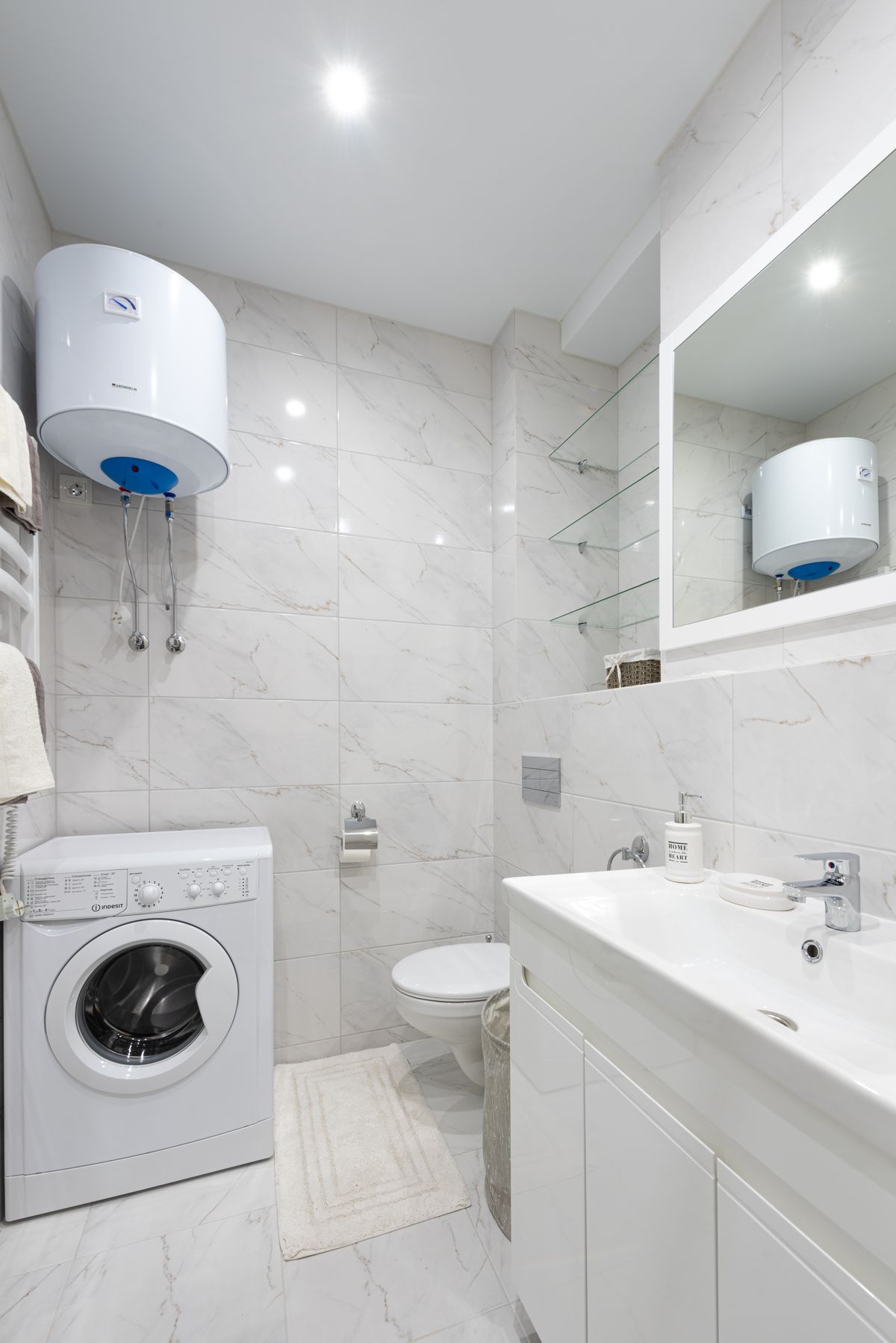
A water heater thermostat replacement on an electric tank starts with switching the water heater's breakers off at the panel, as the Department of Energy's Building America Solution Center instructs, then removing the access panel, confirming with a meter that the power is off, and swapping the thermostat. Fixr prices the job at $100 to $250 for parts and labor, updated 29 August 2025. The safety side of doing it yourself is covered further down this page.
Most electric tank water heaters run two thermostats, one upper and one lower, wired so only one heating element is powered at a time. GSW's technical bulletin on dual element operation, dated 4 October 2005, calls it a flip or flop system: the upper thermostat heats first, then hands power down to the lower thermostat.
On a 240 volt tank, both elements always have 120 volts present, and the thermostat supplies the second leg needed to complete the circuit. Starting from a cold tank, the upper thermostat takes priority, heats the top, then flips power to the lower thermostat once its setpoint is reached. During normal use, cold water entering the bottom triggers the lower thermostat first, and the upper thermostat only takes back over after a significant draw.
A separate high limit switch sits above the upper thermostat and cuts power to both thermostats and both elements if the water gets unsafely hot, resetting with a red button. GSW's bulletin notes that a high limit switch tripping repeatedly points to a deeper problem, and calls for a qualified technician rather than repeated resets.
A failed upper thermostat and a failed upper heating element produce the identical symptom: no hot water at all. Fixr's national repair guide prices them separately, $100 to $250 for the thermostat against $200 to $750 for the element, which is exactly why the two get confused and why a technician tests both before replacing either.
The overlap traces back to the wiring described above. Because the upper thermostat has to hand power down to the lower thermostat before the bottom of the tank ever heats, a dead upper thermostat and a dead upper element both stop the whole tank cold, per GSW's documented sequence of operation. A lower thermostat or lower element failure reads differently: the top of the tank still heats, so there is a short burst of hot water before it runs cold.
That full symptom by symptom pattern, along with what each part costs to fix, is covered in Water Heater Problems: What Is Wrong and What Repairs Cost. This page is not re-running that diagnosis, since the point here is the cost once the part is identified, not the test itself.
In an RV, the thermostat and ECO sit in the ignition circuit; see RV water heater diagnosis.
Gas water heaters do not carry a stand-alone thermostat the way electric units do. Temperature control is built into the gas control valve, priced at $100 to $300 for parts and labor per Fixr's national guide, slightly above the $100 to $250 for an electric thermostat because the part also regulates gas flow to the burner and pilot.
That is why a repair estimate on a gas unit's temperature complaint often reads gas valve rather than thermostat. It is the same job with a different name. A pilot that will not stay lit is a separate failure, usually the thermocouple, priced at $150 to $325 per Fixr, not the control valve itself.
| Gas-side part | Typical range | Midpoint |
|---|---|---|
| Gas control valve, thermostat equivalent | $100 to $300 | about $200 |
| Thermocouple | $150 to $325 | about $238 |
| Pilot light assembly | $75 to $150 | about $113 |
Source: Fixr, Water Heater Repair Cost, updated 29 August 2025.
Anyone who smells gas near the unit should not troubleshoot any of this. See the safety guidance in Water Heater Problems: What Is Wrong and What Repairs Cost.
Power off at the breaker comes first on any electric water heater, before the access panel is removed. The Department of Energy's Building America Solution Center instructs flipping the water heater's breakers to off at the electrical panel, and on a gas unit, following the manual, which may call for shutting the gas valve or setting it to pilot.
Removing the panel and testing with a meter is within reach for a comfortable homeowner. What makes it a job worth handing off is what sits behind the panel: 240 volts, and a tank holding water well above the 120°F setting the Consumer Product Safety Commission recommends.
| Water temperature | Time to a third degree burn in most adults |
|---|---|
| 120°F | 5 minutes |
| 150°F | 2 seconds |
Source: U.S. Consumer Product Safety Commission, Avoiding Tap Water Scalds, Publication 5098, March 2012.
If there is any doubt about which breaker feeds the unit, or how to confirm power is actually off before touching a wire, that is the point to call a licensed professional instead of guessing.
Every number on this page traces to a published, dated source. Cost figures come from two national cost guides, named as guides rather than presented as this site's own pricing. The two thermostat wiring sequence comes from a water heater manufacturer's technical bulletin, and the safety guidance comes from a U.S. Department of Energy program and a federal consumer safety agency.
For the full symptom by symptom diagnosis, see Water Heater Problems: What Is Wrong and What Repairs Cost and the water heater cost hub.
Fixr's national repair guide, updated 29 August 2025, prices a thermostat replacement at $100 to $250 for parts and labor combined. A broader repair visit that includes inspecting and adjusting the thermostat, rather than a stand-alone swap, runs $303 to $365 per Homewyse's May 2026 estimate. Both are national ranges, not a quote for your unit.
Most electric tank units run an upper and a lower thermostat wired so only one heating element is powered at a time, a design GSW's technical bulletin calls a flip or flop system. The upper thermostat heats first, then hands power to the lower thermostat once its setpoint is met.
A failed upper thermostat and a failed upper heating element both cause total loss of hot water, since neither lets power reach the lower thermostat. Fixr prices them differently, $100 to $250 for the thermostat against $200 to $750 for the element, so testing before replacing matters. See [Water Heater Problems](/problems/) for the full symptom breakdown.
Gas units do not have a stand-alone thermostat. Temperature control is built into the gas control valve, priced at $100 to $300 for parts and labor per Fixr's national guide, updated 29 August 2025, compared with $100 to $250 for an electric thermostat. A pilot that will not stay lit usually points to the thermocouple, priced at $150 to $325.
Yes. The Department of Energy's Building America Solution Center instructs flipping the water heater's breakers to off at the electrical panel before opening an electric unit, and following the manual on a gas unit, which may call for shutting the gas valve or setting it to pilot. This is a safety step, not an optional one.
The Consumer Product Safety Commission recommends setting a water heater thermostat to 120°F. Its data shows why: at 150°F, most adults suffer a third degree burn in about two seconds, compared with roughly five minutes at 120°F. That guidance applies to the setting on the new thermostat, not just the old one.
Independent Research
Published ranges for tank and tankless replacement, the failures that justify a repair, and the ones that do not. Sourced, dated, and free to read.