Installing a tankless water heater typically runs $600 to $1,850 in labor alone, per Angi, accessed August 2026, while Fixr prices gas, propane or oil tankless labor at $900 to $1,700, dated January 31, 2025. That sits well above a tank swap's $150 to $450 flat labor charge, because tankless work takes measurably more skilled hours.
Hot Water Brief is an independent cost-research site. We are not a contractor and do not perform the work ourselves.
This page isolates tankless labor from the unit's own price. For a tank swap's labor line, see the tank swap labor cost guide.
| Fuel type | Labor cost | Source, dated |
|---|---|---|
| Electric | $500 to $1,000 | Fixr, Jan 2025 |
| Gas or propane | $900 to $1,500 | Fixr, Jan 2025 |
| Oil | $900 to $1,700 | Fixr, Jan 2025 |
| All fuel types, average | $600 to $1,850 | Angi, Aug 2026 |
| Tank swap, for contrast | $150 to $450 flat | Angi, Jul 2026 |
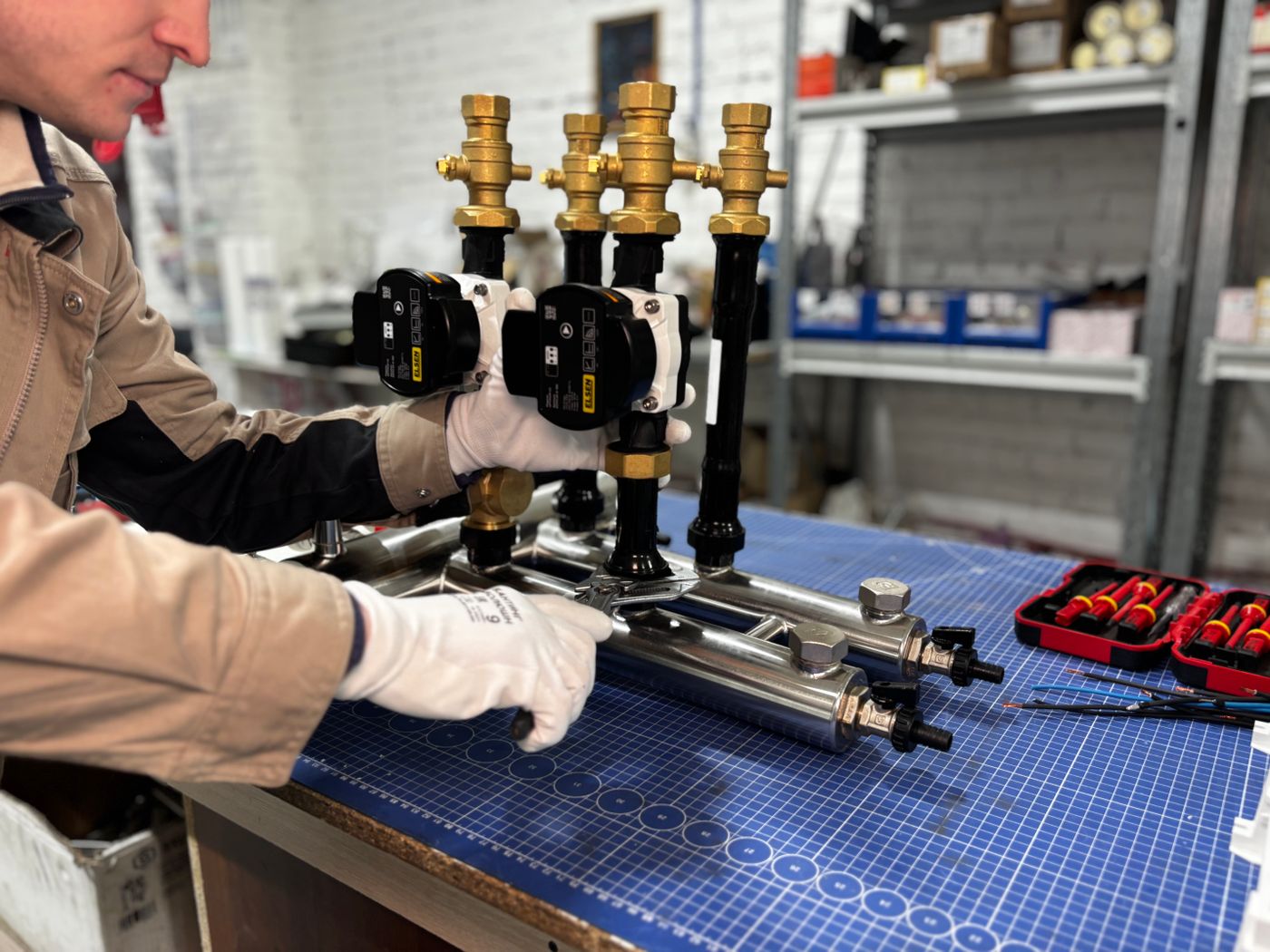
A tankless installation typically takes 6 to 10 hours of skilled labor, per Fixr, dated January 31, 2025, depending on heater type, location and fuel. A like-for-like tank swap is commonly billed near a 2-hour minimum instead, roughly a third to a fifth of that time.
Angi's tankless guide, accessed August 2026, puts straightforward cases closer to three hours, rising toward Fixr's range once the job needs new venting, a bigger gas line or added wiring, work a tank swap skips because it reuses the existing flue, gas line and outlet.
| Job | Typical labor hours | Source, dated |
|---|---|---|
| Tank swap, like-for-like | Close to a 2-hour minimum | Homewyse, via the tank labor guide, May 2026 |
| Tankless, straightforward case | About 3 hours | Angi, Aug 2026 |
| Tankless, typical range | 6 to 10 hours | Fixr, Jan 2025 |
Venting and gas supply are the two biggest tankless-specific jobs. A gas tank draws 30,000 to 50,000 Btu per hour through a 1/2 inch line and vents up a chimney; a gas tankless unit draws up to 199,900 Btu per hour, needs a 3/4 inch line, and vents through an outside wall, per the Building America Solution Center (BASC), August 2021.
Non-condensing models exhaust near 300 degrees Fahrenheit and need stainless steel venting; condensing models cool exhaust to about 100 degrees and can use PVC instead, per the same source.
| Spec | Storage tank | Tankless (gas) | Source, dated |
|---|---|---|---|
| Gas input | 30,000 to 50,000 Btu/h | up to 199,900 Btu/h | BASC, Aug 2021 |
| Gas branch line | commonly 1/2 inch | often 3/4 inch | BASC, Aug 2021 |
| Vent path | up a chimney or flue | sideways through an outside wall | BASC, Aug 2021 |
| Vent material | atmospheric flue | stainless steel, or PVC if condensing | BASC, Aug 2021 |
Yes, on two fronts. Combustion air sizing scales with the unit's Btu rating, per an ICC CodeNotes guide reissued 2024, and condensing models add a routed condensate line, since Navien states the condensate runs an acidic pH of 3 to 5 and often needs a neutralizer before reaching a household drain.
Under the 2021 International Fuel Gas Code, indoor combustion air alone needs 50 cubic feet per 1,000 Btu of input, a calculation that changes once a tankless unit's draw tops a tank's rating. BASC's checklist also requires minimum R-3 pipe insulation and a 3/4 inch or larger drain pan line, items a tank installation never needs.
| Requirement | What it involves | Source, dated |
|---|---|---|
| Combustion air, indoor | 50 cubic feet per 1,000 Btu/h of input | ICC CodeNotes, 2024 |
| Condensate line | Acidic, pH 3 to 5, often needs a neutralizer | Navien, Aug 2026 |
| Pipe insulation | Minimum R-3 on accessible piping | BASC checklist, Aug 2026 |
| Drain pan line | 3/4 inch or larger | BASC checklist, Aug 2026 |
Often, yes. A storage tank typically needs no dedicated circuit, but a gas tankless unit's control board and igniter still need a 120 volt AC outlet, per BASC, and an electric tankless unit commonly needs multiple 240 volt circuits Homewyse prices at $741 to $910 each, dated May 2026.
If the panel lacks room, Homewyse prices a basic panel upgrade at $1,325 to $1,606, also dated May 2026: work a same-spot tank swap essentially never triggers, since it reuses the outlet or gas line already there.
| Fuel type | New wiring typically needed | Published cost | Source, dated |
|---|---|---|---|
| Gas tankless | One 120 volt AC outlet for controls and igniter | Folded into installed totals | BASC, Aug 2021 |
| Electric tankless | One or more 240 volt, 40 amp circuits | $741 to $910 per circuit | Homewyse, May 2026 |
| Either, if panel lacks capacity | Basic 100 amp, 20-space panel upgrade | $1,325 to $1,606 | Homewyse, May 2026 |
Sometimes, but the bigger driver is hours, not rate. Fixr's tankless guide, dated January 31, 2025, prices plumber labor for tankless jobs at $75 to $130 an hour, inside the broader $45 to $200 range Angi and Fixr publish for water heater work generally, so the extra bill mostly comes from added hours, not a higher rate.
Two adjacent trades add their own rates on complex jobs: Fixr prices electrician time for wiring at $65 to $85 an hour and carpenter time for a wall opening at $70 an hour, both dated January 31, 2025. Neither typically appears on a straightforward tank swap.
| Trade | Hourly rate | Source, dated |
|---|---|---|
| Plumber, tankless-specific jobs | $75 to $130 | Fixr, Jan 2025 |
| Plumber, water heater work generally | $45 to $200 | Angi, Jul 2026, and Fixr, Jan 2026 |
| Electrician, wiring upgrades | $65 to $85 | Fixr, Jan 2025 |
| Carpenter, wall opening work | $70 | Fixr, Jan 2025 |
Every figure above is listed here with its publisher and date. If a number is not traceable to this list, it is not on this page.
Prices move. Check these dates against the day you are reading this.
Fixr prices a typical job at 6 to 10 hours, dated January 31, 2025; Angi cites around three hours for straightforward cases, accessed August 2026. Both sit well above a tank swap's roughly 2-hour minimum; see [the tank labor cost guide](/guides/labor-cost-water-heater-replacement/).
Mainly scope a tank swap skips: resizing the gas line for a higher Btu draw, running a new sidewall vent, adding a dedicated circuit, and, on condensing models, routing a condensate line, all sourced above to BASC and Homewyse.
Fixr's tankless guide prices labor at $75 to $130 an hour, dated January 31, 2025, inside the wider $45 to $200 range published generally for water heater work. The bigger driver is that tankless jobs run 6 to 10 hours, not close to 2.
Often. Homewyse prices a new 240 volt circuit at $741 to $910, dated May 2026, plus a panel upgrade at $1,325 to $1,606 if needed. A gas tankless unit needs far less, just a 120 volt outlet for its controls.
Condensing models produce acidic condensate, pH 3 to 5 per Navien, needing a routed drain line and often a neutralizer. BASC's checklist also calls for R-3 pipe insulation and a 3/4 inch drain pan line, items a tank never needs.
Yes. Angi notes a tight or hard-to-reach spot can raise labor costs by 10 to 15 percent of the project total, accessed August 2026, similar to what [the tank labor cost guide](/guides/labor-cost-water-heater-replacement/) documents for standard tank swaps.
Independent Research
Published ranges for tank and tankless replacement, the failures that justify a repair, and the ones that do not. Sourced, dated, and free to read.